
By Devon Murray
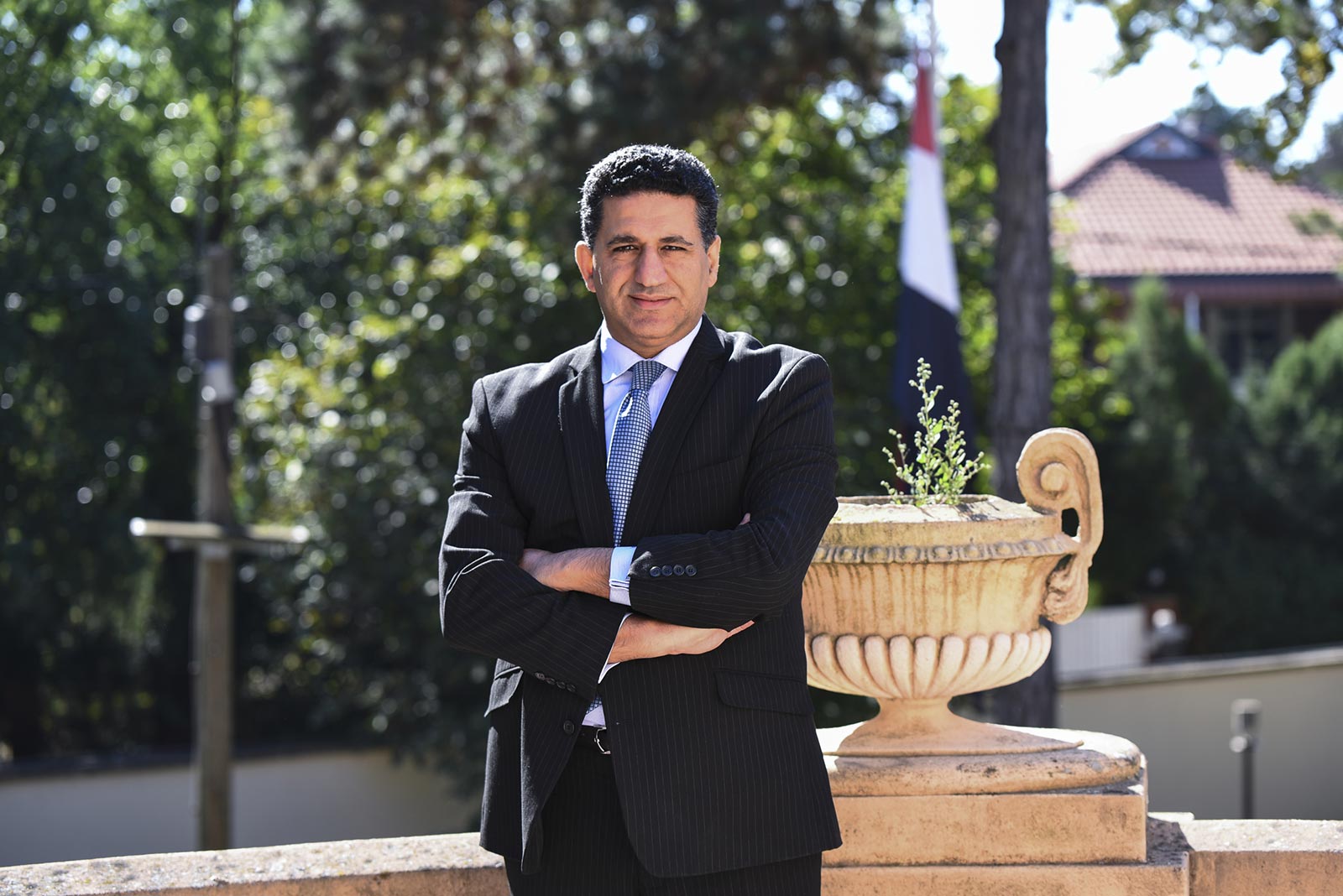
“Go to waste” has never been on Salah El Haggar’s agenda. A mechanical engineering professor at AUC since 1987, El Haggar is a guru when it comes to waste management, renewable energy applications and recycling.
“It’s all about making use of what is normally perceived as garbage or trash. Every single piece of waste can be repurposed with economic profits to nations and individuals alike,” he said, adding that practicing this intense form of recycling will contribute to a stronger economy and open avenues for innovation.
A quick visit to El Haggar’s office at AUC makes it clear that he practices what he preaches. The room is filled with manhole covers, foam glass, pots, sidewalk and pavement blocks, and coffee grinders made from all types of waste — representing the fruits of his labor in encouraging students to conserve resources.

At AUC, El Haggar spearheaded the introduction of “power” as an academic concentration in the mechanical engineering major, and assisted in establishing trash sorting stations on campus and developing the University’s recycling program. He teaches courses on topics ranging from sustainable development in engineering to management of natural resources. “There is a special joy in seeing students innovate when it comes to recycling,” said El Haggar. “They are passionate with amazing ideas.”
In facing climate change, adaptation and mitigation are two categories of action commonly touted by scientists, world leaders and organizations. El Haggar believes utilization is a third category that should also be at the forefront of our minds.
“Utilization is about doing what we can with what we have right now,” explained El Haggar. “If adaptation is building a seawall to protect a city from rising sea levels and mitigation is reducing emissions from factories discharging greenhouse gases that contribute to climate change, then utilization is harnessing and repurposing these emissions to grow algae, which can be used to create biofuels.”
El Haggar wrote a book published by AUC Press in 2015, Sustainability and Innovation: The Next Global Industrial Revolution. According to El Haggar, when the book was released, it provided for the first time worldwide a roadmap for the net zero concept as the next global industrial revolution — one that approaches zero emissions and zero waste according to a scheduled timeline.
“Net zero is the way forward for the entire world; there is no alternative,” affirmed El Haggar, who is president of the Egypt Green Building Council, a nonprofit organization that seeks to raise awareness of and promote sustainable building practices in Egypt.
Among its various projects, the council developed Tarsheed, a green rating system for new and existing buildings, schools, communities and health care facilities that takes into account a building’s water, energy and materials usage — giving it a rating of bronze, silver, gold or platinum depending on the number of points achieved. Tarsheed rating systems are based on the net zero concept.
Investing in green buildings and green tech doesn’t solely benefit the environment, El Haggar said. “Worldwide, there is $24.7 trillion available for green buildings, making the industry attractive to investors and business owners,” said El Haggar.



Leave a Reply